Whippet vs Italian Sighthound: differences and which suits you
Whippets and Italian Sighthounds share deep chests, tucked waists and fine short coats, but Whippets are larger. Both have sighthound backgrounds and may chase moving targets. Small Italian Sighthound size does not remove lead or activity needs.
Explore an Italian Sighthound for smaller size while assessing gentle handling and collision prevention; explore a Whippet for a larger sighthound. Both need gentle, consistent training, secure-fenced activity opportunities and comfortable rest.
Everyday care and appearance
Whippet vs Italian Sighthound: differences and which suits you
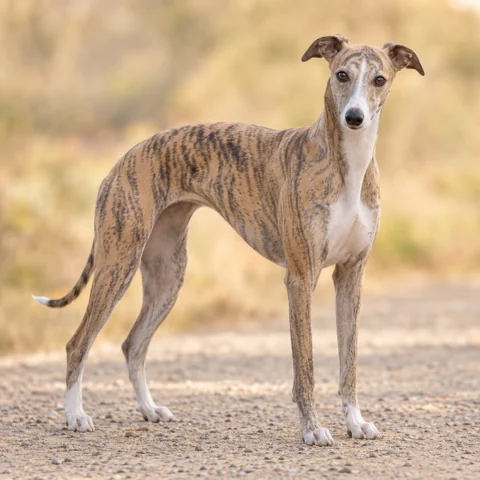
The body combines muscular strength with graceful lines, a deep chest, a tuck-up and a gentle arch over the loin, without exaggeration. Desirable height is 47–51 cm for dogs and 44–47 cm for bitches; the small ears are rose-shaped and the long tail tapers.
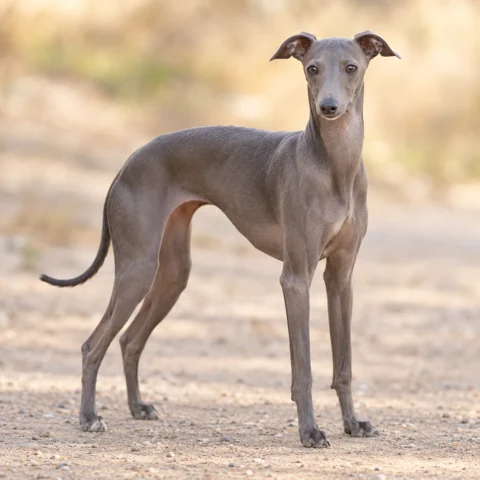
Slender and nearly square, the body is as long as, or just shorter than, the height at the withers; both sexes stand 32–38 cm. Small, high-set ears usually fold back, while the fine, low-set tail curves in its second half.
Coat
The coat is fine, short and close-lying. Any colour or combination is accepted except merle.
The coat is short, fine and silky throughout, with no feathering. Accepted colours are solid black, grey or isabella (pale yellowish beige) in any shade; white is tolerated only on the chest and feet.
Temperament and training
The standard describes a gentle, affectionate, even-tempered dog adaptable to home and sport. These are breed ideals, not a guarantee of how any individual responds to people or animals; reward-based training and gradual exposure to everyday situations help build dependable behaviour.
The standard describes a lively, affectionate and docile dog bred for racing. Positive reinforcement and engaging practice can channel that energy, but the description does not guarantee that every individual welcomes everyone. Introduce new situations at the dog's own pace.
Exercise, grooming and daily care
Brush the short coat periodically with a soft brush or grooming mitt, and check skin, ears and nails. Offer opportunities to run in a secure area alongside play and progressive training. Use a lead where needed and check fencing before off-lead time to manage possible pursuit of moving targets. Provide a steady routine, a place to rest and consistent, gentle guidance at home.
Wipe or softly brush the short coat regularly, and check skin and nails. Its racing background calls for movement and chase-style play in securely enclosed spaces, with a lead used where needed outdoors. Reward-based practice in recall, settling and handling helps make home life manageable. Supervise rough play around its slight frame.
Common questions
Which is easier to care for: Whippet or Italian Sighthound?
Explore an Italian Sighthound for smaller size while assessing gentle handling and collision prevention; explore a Whippet for a larger sighthound. Both need gentle, consistent training, secure-fenced activity opportunities and comfortable rest.
Can either live in an apartment?
An apartment can be assessed with quiet rest, suitable walks and safe activity. Manage doorway escapes, small moving animals and unsafe jumps. Fine short coats simplify grooming, but safety and temperature comfort still require individual attention.
Sources and limits
Recommendations are editorial interpretations of the breed profiles, not guarantees about an individual dog. Age, breeding, socialisation, training and health matter; consider the individual dog, your time and budget.